
Turning the Hardest Conversation Into an Act of Love


For years, Mary Smith lived independently in the home where she had raised her children. At 78, she was still active in her church, still tended to the garden she loved, and still looked forward to Sunday dinners surrounded by her family.
Mary was the mother of three adult children.
Her oldest daughter, Lisa, lived nearby and visited often. Lisa was organized, thoughtful, and usually the one who accompanied Mary to doctor’s appointments.
Her son, David, lived about an hour away. He loved his mother deeply but often struggled to talk about emotional topics. When difficult subjects came up, he tended to stay practical and quiet.
Her youngest daughter, Karen, lived out of state and called Mary several times a week. Karen worried about being far away and often felt guilty that she could not be present as often as Lisa.
Mary also had four grandchildren, who knew her as the grandmother who never forgot birthdays, always cooked too much food, and filled every family gathering with stories.
But lately, Lisa had noticed small changes.
Mary tired more easily. Her doctor visits had become more frequent. She sometimes needed help with things she used to do without thinking. Still, the family rarely talked about the future. Like many families, the Smiths avoided conversations about illness, aging, care, and end-of-life wishes because the subject felt too heavy.
Lisa often wondered quietly:
Who would make decisions if Mom could not speak for herself?
What treatments would she want?
Would she want to remain at home?
What would dignity mean to her?
What would matter most if her health changed?
No one knew for certain because the conversation had never truly begun.
At a community workshop on advance care planning, Lisa met Emily, a social worker who often helped families navigate difficult conversations about aging, illness, care preferences, and decision-making. Emily explained that advance care planning was not only about completing forms. It was about helping families understand a person’s values before a crisis forced decisions to be made.
“Start with life,” Emily told Lisa. “Ask what matters most before you ask about medicine. When families understand the person, the paperwork has meaning.”
That stayed with Lisa.
One afternoon, Lisa visited her mother and sat with her at the kitchen table. She did not begin with legal forms, hospitals, or medical procedures. Instead, she remembered Emily’s advice and began with a simple question:
“Mom, what makes a good day for you?”
Mary looked surprised at first. Then she smiled.
“A good day?” she said. “Well, I suppose it starts with coffee by the window. Checking on my roses. Hearing from one of you kids. And ending the day knowing everyone is all right.”
That small question opened the door.
Over the next few weeks, Lisa and Mary continued talking. Some days they spoke for only a few minutes. Other days, they sat together for hours at the kitchen table. When Lisa felt unsure how to continue, she reached back out to Emily, who reminded her not to rush.
“These conversations are not interviews,” Emily said. “They are invitations. Let your mother’s stories lead you.”
So Lisa asked one question at a time:
“What helps you feel most like yourself?”
“What parts of your daily life would you want to protect if your health changed?”
“What would you hope for most if you were seriously ill?”
“What would you worry about most?”
“What kind of care would help you feel respected?”
“Who would you trust to speak for you if you could not speak for yourself?”
At first, Mary hesitated. These were not easy questions. But because the conversation began with her life rather than her death, she slowly opened up.
She talked about her faith and how prayer brought her peace. She talked about her garden, her church community, and the importance of Sunday dinners. She shared stories about raising Lisa, David, and Karen, caring for her late husband, and the values she hoped her grandchildren would carry forward.
Mary said independence mattered deeply to her. But as she reflected, she realized independence did not mean doing everything alone. It meant being included in decisions. It meant being treated with respect. It meant having her dignity protected.
One evening, Lisa asked, “If there ever came a time when treatment could keep you alive but you could not enjoy the people and things that matter most to you, what would you want us to understand?”
Mary was quiet for a long time.
Then she said, “I would want you to remember that living is more than breathing. I want comfort. I want peace. I want my family near me. And I do not want you all fighting or guessing.”
That sentence became Mary’s guiding message.
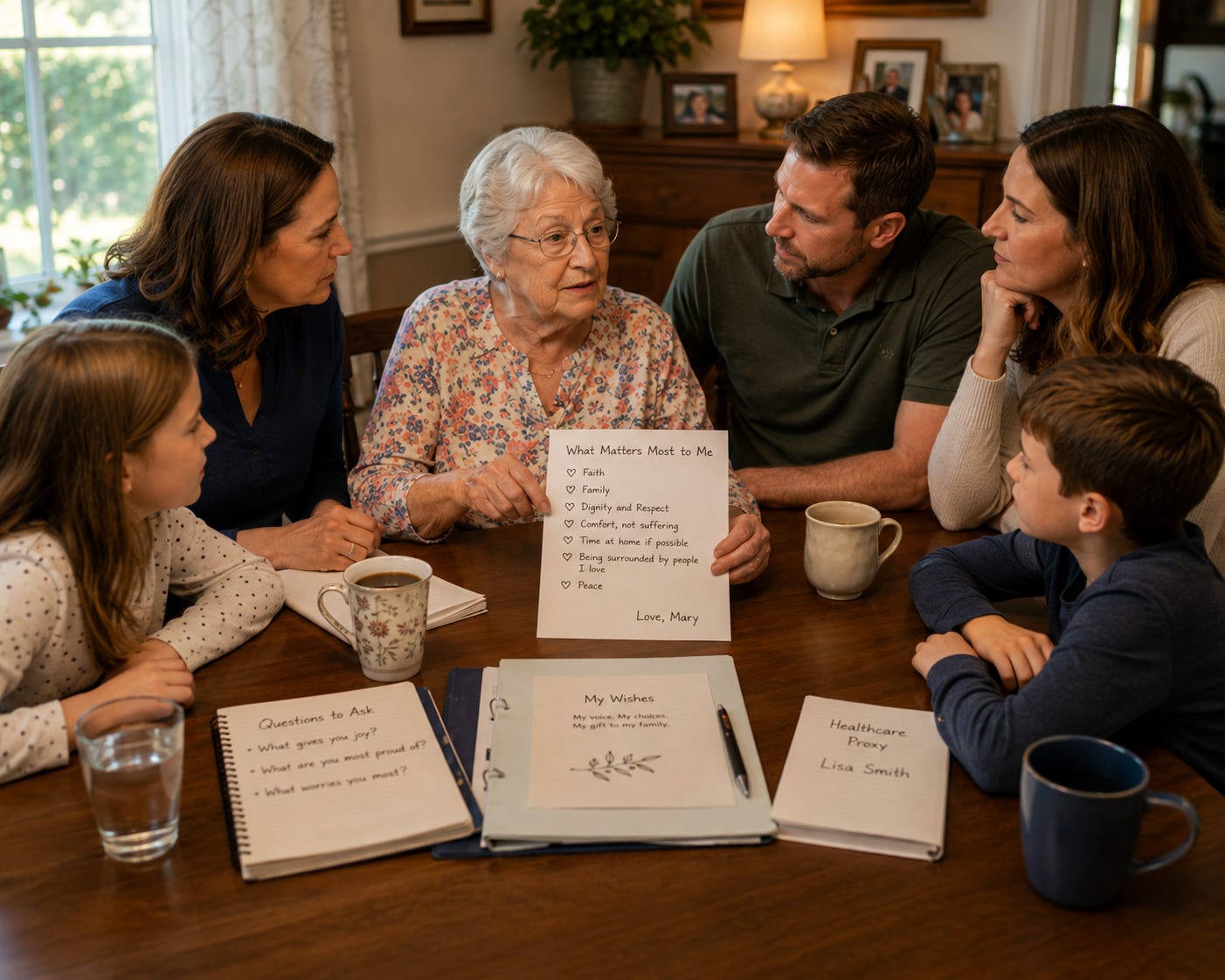
With Mary’s permission, Lisa invited Emily to join the family for a conversation after Sunday dinner. Lisa wanted David and Karen to hear Mary’s wishes directly, not secondhand.
David came with his wife, Angela, who had always been close to Mary and often helped with errands when she could. Karen joined by video call from out of state, along with her husband, Michael. Mary’s oldest granddaughter, Rachel, was also present because Mary wanted at least one of the grandchildren to understand why these conversations mattered.
Emily did not tell the family what Mary should choose. Instead, she helped create a calm space where everyone could listen.
She began by saying, “Today is not about making frightening decisions. It is about understanding Mary’s voice, her values, and what she wants you to know if a hard moment ever comes.”
The conversation was emotional, but it was also healing.
Lisa shared that she worried about making the wrong decision if something happened suddenly.
David admitted that he avoided the topic because he did not want to imagine losing his mother.
Karen said being far away made her afraid that decisions would happen without her understanding what Mary wanted.
Angela asked practical questions about what kind of support Mary might need at home.
Rachel listened quietly at first, then told her grandmother, “I just want to know how to honor you.”
Mary looked around at her family and answered in her own words.
She told them what mattered most: faith, family, dignity, comfort, and time at home if possible. She explained that she would accept treatment if there was a reasonable chance of recovery, but she did not want prolonged suffering if recovery was unlikely.
Then she named Lisa as the person she trusted to speak for her if she could not speak for herself. Mary chose Lisa not because she loved David or Karen any less, but because Lisa lived nearby, understood her medical history, could remain calm, ask questions, and advocate for her wishes.
Mary also asked David to help Lisa think through major decisions if time allowed, because she trusted his steady judgment. She asked Karen to be involved in family conversations by phone or video whenever possible, because she wanted her youngest daughter to feel included even from a distance.
Emily helped the family understand that choosing a healthcare decision-maker was not only about love. It was about choosing someone who could represent Mary’s wishes clearly, even under pressure.
Together, the family completed the necessary planning documents. Mary also wrote a letter to the people she loved. In it, she shared what she was grateful for, the lessons she hoped Lisa, David, Karen, and the grandchildren would remember, and the love she wanted them to carry forward.
What surprised the Smith family most was that the process did not make them feel hopeless.
It brought them closer.
Old misunderstandings softened. Lisa felt less alone. David felt relieved that talking about the future did not mean giving up. Karen felt included despite the distance. Rachel felt grateful to hear her grandmother speak honestly about what mattered most.
Questions that had been left unspoken for years were finally answered. Family members shared memories, expressed gratitude, and said things that often remain unsaid until it is too late.
Mary later told Lisa, “I thought this conversation would be about dying. Instead, it reminded me how much I have lived.”
Several months later, Mary experienced a serious health setback and was hospitalized. The moment the family had feared arrived quickly. Doctors explained the options, the risks, and the uncertainty.
But this time, the family was not left in silence, trying to guess.
They had Mary’s words.
Lisa knew what comfort meant to her. David knew that strength did not always mean continuing treatment at all costs. Karen knew that Mary wanted peace, dignity, and family connection, even if decisions were difficult. Rachel remembered her grandmother saying that being loved and respected mattered more than simply being kept alive.
Because the conversations had already happened, Lisa could advocate with clarity. David could support her without second-guessing. Karen could participate from a distance without feeling excluded. Emily also helped the family communicate Mary’s wishes to the care team, making sure the medical discussion stayed connected to Mary’s values rather than fear alone.
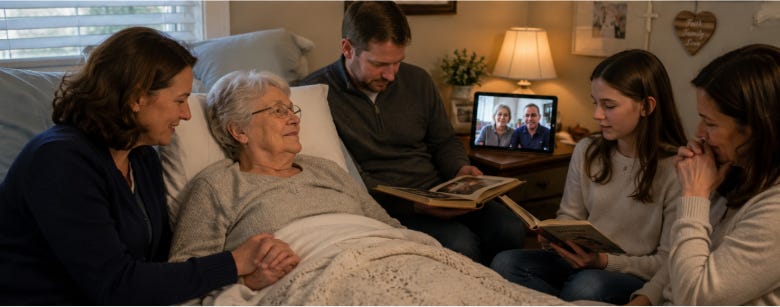
The family was able to focus less on panic and more on honoring Mary.
When Mary’s health continued to decline, she chose comfort-focused care surrounded by family. Lisa stayed by her bedside. David brought old photo albums. Karen called every day and later traveled in to be with her mother. Angela helped coordinate meals and visitors. Rachel read aloud from Mary’s favorite prayers and family letters.
In her final days, Mary was peaceful.
After her passing, the Smith family grieved deeply. But alongside their grief was a profound sense of comfort. They knew they had honored her wishes. They had not been forced to make decisions in crisis without guidance. Most importantly, they had been given the gift of meaningful conversations before time ran out.
The Smith family learned that advance care planning is not merely a collection of legal documents. It is a process of reflection, communication, and love.
It begins with questions like:
What matters most to me?
What does dignity look like for me?
What kind of care would reflect my values?
Who do I trust to speak for me?
What do I want my loved ones to know before a crisis comes?
What began as the hardest conversation became one of the greatest gifts they ever gave each other.
Because when the time came to ask, “What would Mary want?”
They did not have to guess.
They already knew.
Create Your Own Plan
The best time to begin these conversations is before a crisis. Start with one question. Write down what matters most. Share your wishes with someone you trust.
Create your own reflection plan with this guided workbook: Aging with Intention: A Reflection Workbook for Your Future: Turning the Hardest Conversation Into an Act of Love